 Government & Compliance Audits
 SOC 1
SOC 1 SOC 2
SOC 2 SOC 3
SOC 3 Subrecipient Monitoring Services
 Attestation Engagements
 Employee Benefits Plans (ERISA)
 HIPAA
HIPAA Soc for Cybersecurity
 SOC for Supply Chain
  SOC for AI
 SOC for Cloud Security
 Grant Compliance Consulting
 Virtual CISO (vCISO)
 NIST
NIST ISO 27002
 SOC
SOC Business Strategy & Excellence
 Business Intelligence & Data Analytics
 TGC Reviews (SAS 145)
 Application Control Testing
 SOC Control Design and Effectiveness Testing
 Bookkeeping
 Daily Operations
 Outsourced CFO & Advisory
 Tax Planning
 Tax Reporting
 IRS & FTB Representation
 Tax Strategy & Compliance
 Corporate Tax Provisions ASC 740
 Nonprofit & Tax-Exempt

WHAT THIS ARTICLE COVERS
- The regulatory environment governing government audits in the United States
- Common year-end financial reporting activities in the public sector
- Recent GASB standard updates affecting government financial statements
- Federal compliance considerations for entities that expend federal awards
- How industry practices around year-end documentation have evolved
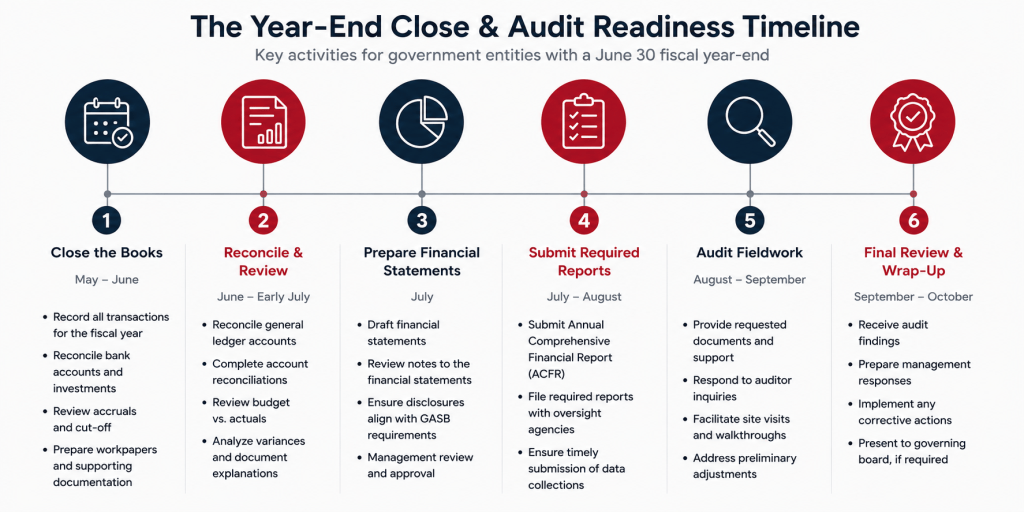
Government finance offices operating on a June 30 fiscal year end follow a predictable sequence of reconciliation, reporting, and compliance activities before audit fieldwork begins. This guide summarizes the most common requirements and recent accounting standards affecting public entities.
For government entities that operate on a June 30 fiscal year-end, the close of each fiscal year marks a period of significant activity across finance and accounting departments. Municipalities, special districts, counties, and other public agencies typically enter a concentrated window of year-end reconciliation, documentation review, and financial reporting preparation in advance of their annual audit engagements.
This article provides an informational overview of the types of activities that commonly occur in government finance offices during this period, the regulatory frameworks that shape those activities, and the industry trends that are influencing how public sector finance teams approach year-end.
The Regulatory Environment for Government Audits
Government auditing in the United States is governed by a distinct set of standards and frameworks that differ from those applied in commercial audit engagements. Understanding this landscape is foundational for finance professionals working in or with the public sector.
Generally Accepted Government Auditing Standards (GAGAS)
The U.S. Government Accountability Office (GAO) publishes Generally Accepted Government Auditing Standards, commonly referred to as the Yellow Book. GAGAS establishes requirements for the competence, independence, and professional judgment of auditors, as well as standards for performing and reporting on financial audits, attestation engagements, and performance audits of government entities and programs that receive government funding.
The most recent revision to GAGAS was issued in 2024. Among its most significant changes, the revision aligned GAGAS quality management requirements with the AICPA’s risk-based Statements on Quality Management Standards (SQMS) framework, moving away from a policies-based model toward a system that requires audit organizations to identify and respond to firm-specific quality risks. The revision also updated the independence conceptual framework governing nonaudit services, refining how auditors evaluate and document threats to independence when providing services beyond the audit itself. The revised standards are effective for financial audits, attestation engagements, and reviews of financial statements for periods beginning on or after December 15, 2025, with the same effective date applying to performance audits. Government finance teams generally become familiar with these standards as part of their ongoing audit relationships.
Uniform Guidance and the Single Audit
Entities that expend $1,000,000 or more in federal financial assistance during a fiscal year are subject to the requirements of 2 CFR Part 200, commonly known as the Uniform Guidance. Under these provisions, such entities are required to undergo a Single Audit (or in some cases a program-specific audit), which includes an examination of the entity’s financial statements and its compliance with the requirements of each major federal program.
The Single Audit process includes the preparation of a Schedule of Expenditures of Federal Awards (SEFA), identification and testing of major programs, and reporting on internal controls over compliance. The threshold was raised to $1,000,000 from the prior $750,000 level as part of the 2024 revision to 2 CFR Part 200, applicable to fiscal years beginning on or after October 1, 2024 — meaning it applies to the current audit cycle for June 30 fiscal year-end entities, whose fiscal year began July 1, 2025.
The Single Audit process includes the preparation of a Schedule of Expenditures of Federal Awards (SEFA), identification and testing of major programs, and reporting on internal controls over compliance. The requirements have remained a consistent framework since the consolidation of prior OMB circulars in 2014, though the $750,000 threshold was increased from $500,000 in 2015.
Regulatory Note: The 2024 updates to 2 CFR Part 200 increased the Single Audit threshold from $750,000 to $1,000,000, raised the Type A program threshold correspondingly, and introduced changes to subrecipient monitoring requirements, indirect cost negotiations (including a higher de minimis indirect cost rate), and procurement standards. Because effective dates and transition treatment can vary by award and by federal awarding agency, government finance professionals should confirm applicability with their federal awarding agencies or pass-through entities and review OMB’s official guidance summaries for a full account of what changed.
GASB Standards: Recent and Active Updates
The Governmental Accounting Standards Board (GASB) is the authoritative standard-setting body for state and local government accounting and financial reporting in the United States. Over the past several years, GASB has issued several significant standards that have reshaped how government entities account for and disclose certain transactions.
GASB Statement No. 87 — Leases
GASB 87, which became effective for fiscal years beginning after June 15, 2021, established a single model for lease accounting in governmental financial statements. Under this standard, most leases are recorded as right-of-use assets and corresponding lease liabilities, replacing the prior operating/capital lease distinction. Many government entities completed their initial implementation in fiscal years 2022 and 2023, though ongoing application and proper classification of new arrangements remains an area of attention.
GASB Statement No. 96 — Subscription-Based Information Technology Arrangements (SBITAs)
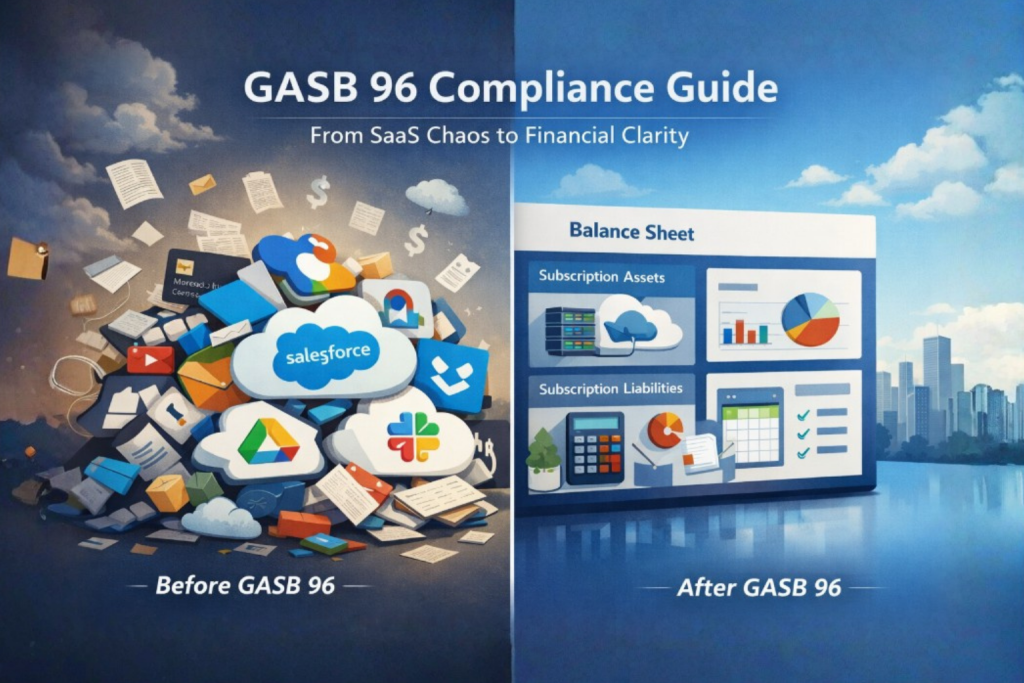
GASB 96, effective for fiscal years beginning after June 15, 2022, extended similar accounting treatment to subscription-based IT arrangements such as cloud computing and software-as-a-service contracts. Government entities are required to recognize a right-to-use subscription asset and a corresponding subscription liability for qualifying SBITAs. Implementation continues to be an active area as technology contracts are reviewed and assessed.
GASB Statement No. 94 — Public-Private and Public-Public Partnerships
GASB 94, effective for fiscal years beginning after June 15, 2022, addressed the accounting and financial reporting for public-private and public-public partnership arrangements, as well as availability payment arrangements. This standard is particularly relevant for entities with long-term infrastructure or service arrangements involving private operators.
GASB Statement No. 101 — Compensated Absences
GASB 101, effective for fiscal years beginning after December 15, 2023, updated the recognition and measurement requirements for compensated absences (leave benefits). The standard replaces GASB Statement No. 16 and establishes a consistent approach to recognizing leave liabilities, including vacation, sick leave, and other types of paid time off.
GASB Statement No. 103 — Financial Reporting Model Improvements
GASB 103, effective for fiscal years beginning after June 15, 2025, represents the first significant restructuring of the government financial reporting model since GASB Statement No. 34 was issued in 1999. For entities on a standard July–June fiscal year, this means the first affected reporting year is the one ending June 30, 2026. The standard restructures Management’s Discussion & Analysis into five required sections with a sharper focus on explaining why balances changed rather than restating figures, replaces the “extraordinary items” and “special items” categories with a single “unusual or infrequent items” concept, revises presentation of proprietary fund operating statements, and changes how budgetary comparison schedules and major component unit information are presented. Given the breadth of these changes, June 30, 2026 entities should begin evaluating their MD&A structure and fund statement classifications well ahead of year-end close.
GASB Statement No. 104 — Disclosure of Certain Capital Assets
GASB 104 shares GASB 103’s effective date — fiscal years beginning after June 15, 2025 — and also applies beginning with fiscal years ending June 30, 2026. It clarifies the level of note disclosure required for certain intangible capital assets, including disaggregating lease and public-private/public-public partnership assets by major class, and separately disclosing IT subscription assets in the aggregate. It also establishes a definition for capital assets “held for sale” and requires disclosure of historical cost and accumulated depreciation for those assets by major class. Both standards require retroactive application, so prior-period comparative figures will need to be conformed to the new presentation.
Standards Context: The above is an informational summary of published GASB standards. For the full text of any standard, readers are encouraged to visit the GASB’s official website at http://www.gasb.org. Implementation guidance should be discussed with a qualified accounting professional.
Common Year-End Activities in Government Finance Offices
While specific processes vary by entity size, structure, and software environment, government finance teams typically engage in a range of activities as part of their fiscal year-end close and audit preparation cycle. The following is a general overview of what these activities tend to involve, drawn from widely recognized public sector finance practices.
Ledger Reconciliation and Closing
Year-end reconciliation typically involves matching subsidiary records to general ledger balances across major account categories including cash, receivables, payables, and fund balances. Intergovernmental and interfund transactions are commonly reviewed to verify that amounts are recorded consistently across affected funds.
Capital Asset Recordkeeping
Government entities maintain capital asset registers that track infrastructure, buildings, equipment, and other long-lived assets. Year-end activities often include updating the asset register for new acquisitions and disposals during the fiscal year, verifying depreciation schedules, and reviewing construction-in-progress balances for assets approaching completion.
Financial Statement Preparation
Government financial statements prepared in accordance with GAAP for state and local governments include government-wide financial statements and fund financial statements. Required supplementary information (RSI) includes budgetary comparison schedules and pension-related disclosures. Many entities prepare their own financial statements, while others engage their independent auditors for financial statement preparation services (where permitted).
Grant Closeout and Compliance Review
For entities with active federal or state grant awards, year-end is often a period for reviewing grant expenditures against award conditions, completing required progress and financial reports, and evaluating whether any unspent balances need to be returned. Subrecipient monitoring documentation is also commonly reviewed at year-end.
Industry Trends Shaping Government Year-End Practices
Increased Focus on Internal Controls
Across the government audit industry, there has been a sustained focus on the quality of internal controls over financial reporting. Auditors and oversight bodies alike have emphasized the importance of segregation of duties, supervisory review of journal entries, and documentation practices. Government entities of all sizes have been prompted to assess control environments following high-profile municipal financial failures in prior decades.
Technology and ERP Modernization
Many government entities have invested in enterprise resource planning (ERP) system upgrades and replacements over the past decade. Modern ERP platforms generally offer improved reconciliation, reporting, and workflow capabilities. However, system transitions often introduce temporary complexity in year-end processes as staff adapt to new workflows and data migration is validated.
Staffing and Capacity Challenges
A widely noted trend in public sector finance is the challenge of recruiting and retaining qualified accounting and finance professionals. Competitive private sector compensation, retirements among experienced staff, and the complexity of government accounting standards have contributed to capacity constraints at many agencies. This has increased interest in outsourced and co-sourced accounting services as a means of supplementing internal teams.
Federal Oversight Activity
The post-pandemic period saw a significant increase in federal funding flowing to state and local governments through programs such as the American Rescue Plan Act (ARPA). Federal oversight agencies, including Inspectors General and the Government Accountability Office, have increased scrutiny of how these funds were expended and reported. Entities that received and expended ARPA or other pandemic-era funds have faced heightened compliance documentation expectations.
Industry Observation: Government finance organizations such as the Government Finance Officers Association (GFOA) publish best practice guidance, award programs, and educational resources that many public sector finance teams reference as benchmarks. Their website at http://www.gfoa.org is a publicly available resource for practitioners.
About The Pun Group, LLP — Government Audit Services
The Pun Group, LLP is a certified public accounting firm with a dedicated Government Audit practice serving municipalities, special districts, counties, and other public agencies. Our team is experienced in GAGAS, Single Audit, and state-level audit requirements across multiple jurisdictions.
For more information about our government audit services, visit thepungroup.com or contact our office.
Frequently Asked Questions
Q: What is the difference between a financial audit and a performance audit under GAGAS?
A financial audit under GAGAS examines whether an entity’s financial statements are presented fairly in accordance with the applicable financial reporting framework. A performance audit evaluates whether a program or activity is achieving its objectives effectively, efficiently, and economically. Both types of engagements are governed by GAGAS, but they have different objectives, standards, and reporting requirements.
Q: Who is required to have a Single Audit?
Non-federal entities — including state and local governments, nonprofits, and tribes — that expend $1,000,000 or more in federal financial assistance during a fiscal year are generally required to have a Single Audit in accordance with 2 CFR Part 200. This threshold was raised from $750,000 as part of the 2024 revision to the Uniform Guidance, applicable to fiscal years beginning on or after October 1, 2024. The determination is based on total federal expenditures across all federal awards, not individual award amounts. Entities below the threshold may still be subject to program-specific audits under individual grant agreements.
Q: Where can government finance professionals find updates to GASB standards?
GASB publishes all final standards, exposure drafts, and implementation guidance on its official website at http://www.gasb.org. The site includes a standards codification, plain-language summaries, and a calendar of upcoming effective dates. Many state CPA societies and organizations such as GFOA also publish summaries and training materials.
Q: What resources exist for government finance professionals?
Several professional organizations support government finance practitioners, including the Government Finance Officers Association (GFOA), the National Association of State Auditors, Comptrollers and Treasurers (NASACT), the Association of Government Accountants (AGA), and state-level government finance associations. These organizations offer training, publications, certification programs, and peer networking opportunities.
DISCLAIMER
This article is intended for general informational and educational purposes only. It reflects publicly available regulatory frameworks and industry-recognized practices and does not constitute accounting, legal, financial, or professional advice of any kind. Readers should consult qualified professionals regarding their specific circumstances. The Pun Group, LLP makes no representations or warranties regarding the completeness, accuracy, or applicability of this content to any particular situation.