
 Government & Compliance Audits
 SOC 1
SOC 1 SOC 2
SOC 2 SOC 3
SOC 3 Subrecipient Monitoring Services
 Attestation Engagements
 Employee Benefits Plans (ERISA)
 HIPAA
HIPAA Soc for Cybersecurity
 SOC for Supply Chain
  SOC for AI
 SOC for Cloud Security
 Grant Compliance Consulting
 Virtual CISO (vCISO)
 NIST
NIST ISO 27002
 SOC
SOC Business Strategy & Excellence
 Business Intelligence & Data Analytics
 TGC Reviews (SAS 145)
 Application Control Testing
 SOC Control Design and Effectiveness Testing
 Bookkeeping
 Daily Operations
 Outsourced CFO & Advisory
 Tax Planning
 Tax Reporting
 IRS & FTB Representation
 Tax Strategy & Compliance
 Corporate Tax Provisions ASC 740
 Nonprofit & Tax-Exempt

Key Takeways
- Ongoing monitoring systems proactively track eligibility requirements, FSRS reporting deadlines, and corrective action progress.
- Advisors help cities and districts find weak points in their systems, understand changing federal standards, and prepare for federal and state-level reviews.
- At The Pun Group, we help you build a subrecipient monitoring strategy that can stand up to federal review while ensuring continuous oversight throughout the award lifecycle.
The Role of Monitoring Services in Maintaining Regulatory Compliance in 2025
Monitoring services play three roles in helping cities maintain federal compliance under the updated Uniform Guidance (2 CFR Part 200), which was revised in October 2024 with stricter expectations for subrecipient oversight.
Role 1: Continuous Oversight Throughout Award Lifecycles
Monitoring services establish ongoing surveillance systems that track subrecipient performance from award inception through closeout.
Under 2 CFR 200.332, agencies must monitor subrecipients throughout the entire life of an award, not just during setup.
Monitoring services create systematic review schedules, automate compliance checkpoints, and ensure no critical oversight gaps occur during transitions or staff changes.
Role 2: Risk Management and Early Warning Systems
Monitoring services also conduct risk assessments before and during funding periods to identify compliance issues before they become audit findings.
They analyze subrecipient financial health, past performance, and internal control systems to flag high-risk situations that require increased oversight.
Role 3: Documentation and Audit Readiness
Monitoring services create and maintain the detailed documentation trails required for federal compliance.
They systematically document all oversight activities, track corrective actions through resolution, and organize records for easy retrieval during audits.
This role is especially important given that cities spending $1 million or more in federal funds must complete single audits under Subpart F.
Without proper monitoring services, cities could face serious consequences, including grant modifications, cost disallowances, repayment orders, and audit referrals. All of these can impact their ability to apply for and maintain future funding.
How Advisory Services Bridge Policy and Practice
The biggest challenge cities face is translating federal compliance requirements into working systems that function under real-world conditions. Advisory services fill this gap by converting complex regulatory language into practical, day-to-day procedures that staff can follow consistently.
Here are other ways in which advisory services help public agencies bridge the gap between written policies and working systems:
1. Identify Weak Points in Existing Procedures
Cities usually have subrecipient monitoring procedures on paper, but these have gaps between written protocols and what’s being done. Advisors go over a city’s current practices, compare them with the latest guidelines, and find areas that fall short.
These issues often involve missed documentation, inconsistent review schedules, or vague corrective action language. Advisors help city and district administrations understand who should do what, when, and how, so they aren’t left scrambling when audit notices arrive.
2. Interpret Changing Federal Standards
The language in Uniform Guidance, especially around 2 CFR 200.331, 200.332, and Subpart F, can be technical, dense, and open to misreading. Agencies that operate across multiple programs or funding streams often run into conflicting interpretations of compliance language.
Advisors help make sense of those requirements and translate them into day-to-day procedures. They draw clear lines around what terms like “adequate oversight” or “timely follow-up” mean and how they change depending on the award type or funding agency.
3. Create Scalable Monitoring Systems
Once a city passes federal funds to subrecipients, it becomes responsible for how other organizations manage public dollars. That risk gets harder to manage when monitoring systems rely on spreadsheets, scattered emails, and improvised reminders.
Advisors help cities map their monitoring responsibilities, flag where manual processes are creating compliance risk, and build monitoring systems that work across departments and funding sources.
4. Prepare for Federal and State-Level Reviews
Advisors help test whether policies hold up when reviewed through a compliance lens. They find gaps and provide advice on what documentation should be ready to present. This level of preparation prevents small errors from turning into audit findings or grant conditions that restrict future flexibility.
Advisors also help city teams organize supporting documents for quick access, map responsibilities across employees, and check whether corrective actions have been properly tracked and resolved.
5. Help With System Improvements
Advisory teams reduce the chances of noncompliance by making system improvements that improve the compliance process. These can include setting up shared systems to track corrective actions or clearer procedures for documentation and eligibility reviews.
The federal government is no longer waiting for cities to fix broken monitoring processes on their own. In 2024, the Office of Management and Budget (OMB) updated its Uniform Grant Guidance to make it clear that subrecipient oversight is a shared priority.
Now, recipients are expected to review their subrecipients’ single audit findings, track subaward reporting, and make sure records are complete and accurate. Those updates came in direct response to the issues auditors found in a review, where the U.S. Government Accountability Office (GAO) traced about 45% of audit failures to missing or ineffective systems.
Our team at The Pun Group offers subrecipient monitoring services that safeguard your funding while creating durable compliance systems. Through federal compliance verification, detailed risk assessments, hands-on site monitoring, and corrective action development, we deliver the support needed to maintain funding security.
Trends in Compliance Monitoring Technology for Government Agencies in 2025
Here are three trends in compliance monitoring technology for government agencies this year:
1. Integrated Grant Management Systems (GMS)
Cities are replacing fragmented tracking tools with grant management systems (GMS). These are centralized platforms that manage the full grant lifecycle (including planning, award, monitoring, reporting, and closeout).
These systems standardize reviews, keep documentation in one place, and automatically flag missing data. The result is a more audit-ready workflow, especially for agencies that manage multiple subawards or have recurring funding cycles.
2. AI Oversight
Artificial intelligence is becoming common in tools that analyze risk indicators, predict performance shortfalls, and sort high-volume data sets.
But in California, cities that use AI for funding or compliance decisions have to be able to explain how those systems work and prove they meet transparency standards set by the California Privacy Rights Act (CPRA).
This means any monitoring technology that’s powered by AI has to come with audit-ready logic and opt-out pathways where required.
3. Subrecipient Dashboards
Instead of waiting for quarterly or annual reports, more cities are using monitoring dashboards that track subrecipient spending and deliverables as they happen.
These systems help grant managers understand the reasons behind late reports, budget deviations, or missed milestones. This enables them to take corrective action before those issues show up in an audit.
This change is useful for districts that manage infrastructure or broadband awards under the Bipartisan Infrastructure Law, where federal agencies expect strict oversight of vendor and subrecipient activity.
5 Common Compliance Pitfalls Cities Face
Incomplete or incorrect subaward reporting, gaps in subrecipient oversight, and missed eligibility checks are examples of common compliance pitfalls cities face. Here is how ongoing monitoring and advisory services help cities and districts maintain compliance by avoiding these pitfalls:

1. Incomplete or Incorrect Subaward Reporting
A recent GAO analysis of 3,680 single audit findings from 2022 to 2024 showed that over 500 findings (14%) were linked to incomplete or incorrect subaward reporting.
Ongoing monitoring systems reduce the risk of this happening because they document subrecipient data, like eligibility verification, funding terms, and performance metrics, up front and with automated timelines.
When it’s time to report to FSRS or respond to a federal query, cities can show exactly where each dollar went and what it achieved.
2. Gaps in Subrecipient Oversight
Between 2022 and 2024, the GAO identified 482 single audit findings directly tied to breakdowns in subrecipient monitoring. In hundreds of cases, cities didn’t conduct risk assessments, skipped reviewing audit reports, or failed to follow up when subrecipients missed targets or raised red flags.
Others were traced back to employee shortages, miscommunication, or confusion about who was responsible for what. All of these open the door to fraud, funding misuse, and delayed problem-solving.
Ongoing monitoring places these tasks into an automated schedule. This means systems trigger alerts when reviews are due, log findings as they’re entered, and help cities follow up consistently.
3. Missed Eligibility Checks
Many audit findings stem from failures to verify subrecipient eligibility, especially suspension or debarment status. For example, a prime recipient might award federal funds to multiple subrecipients without checking SAM.gov or documenting any eligibility screening.
That’s a direct violation of federal rules, and it puts cities at risk for funding clawbacks or fraud investigations.
A monitoring system helps prevent this. It creates prompts for eligibility checks, stores verification records in one place, and links them to subaward files. That way, even during employee turnover or peak deadlines, agencies can prove that every partner cleared the required checks before funding moved.
4. Weak or Unenforced Internal Controls
Monitoring services make it easier for cities to follow controls because they formalize how reviews happen, who approves what, and when actions need to be taken. They help cities build compliance into daily operations.
Remember, weak internal controls were the primary cause behind audit findings in the GAO’s 2025 report. In fact, across all subaward-related issues, over 45% of findings pointed to missing procedures, unclear responsibilities, or inconsistent review processes.
5. Missing or Untracked Documentation
In many cases, agencies complete the required steps, like risk assessments or eligibility checks, but have no records to show for it. Such gaps turn routine oversight into an audit risk.
Monitoring systems keep a record of each action as it happens. Risk scores, site visits, approvals, and follow-up plans all leave a digital trail every single time. When auditors review the files, everything is in place.
How Districts Use Advisory Services To Prepare for Federal Oversight and Audits
There are five main ways districts work with advisors to get audit-ready. These include:
- Audit readiness assessments. Advisors conduct full gap analyses comparing current subrecipient files against the documentation rules in 2 CFR 200.333. They also run mock audits with checklist-driven testing of procurement records, timekeeping documentation, and cost allocation methods.
- Mapping out roles and responsibilities. One of the most common issues during audits is confusion over who did what, and when. Advisors help map out clear roles, approval chains, and responsibilities for each stage of grant management.
- Predictive risk targeting. Advisors use historical audit data and trend modeling to understand where future findings are most likely to occur. They identify subrecipients with past issues, flag high-risk spending, and note the areas where most audit exceptions happen. This helps districts focus their limited monitoring resources where they’ll have the biggest impact.
- Subrecipient file trails. Advisors create defensible documentation trails to satisfy A-133 requirements. That means site visit reports with signatures, risk assessments updated annually, and corrective actions tracked through to resolution.
- Finding remediation roadmaps. When issues pop up, advisors classify them according to severity and write corrective action plans that resolve both the audit and the underlying system weakness. They also help draft formal response letters that demonstrate accountability.
5 Steps for a Compliance-First Culture in 2025
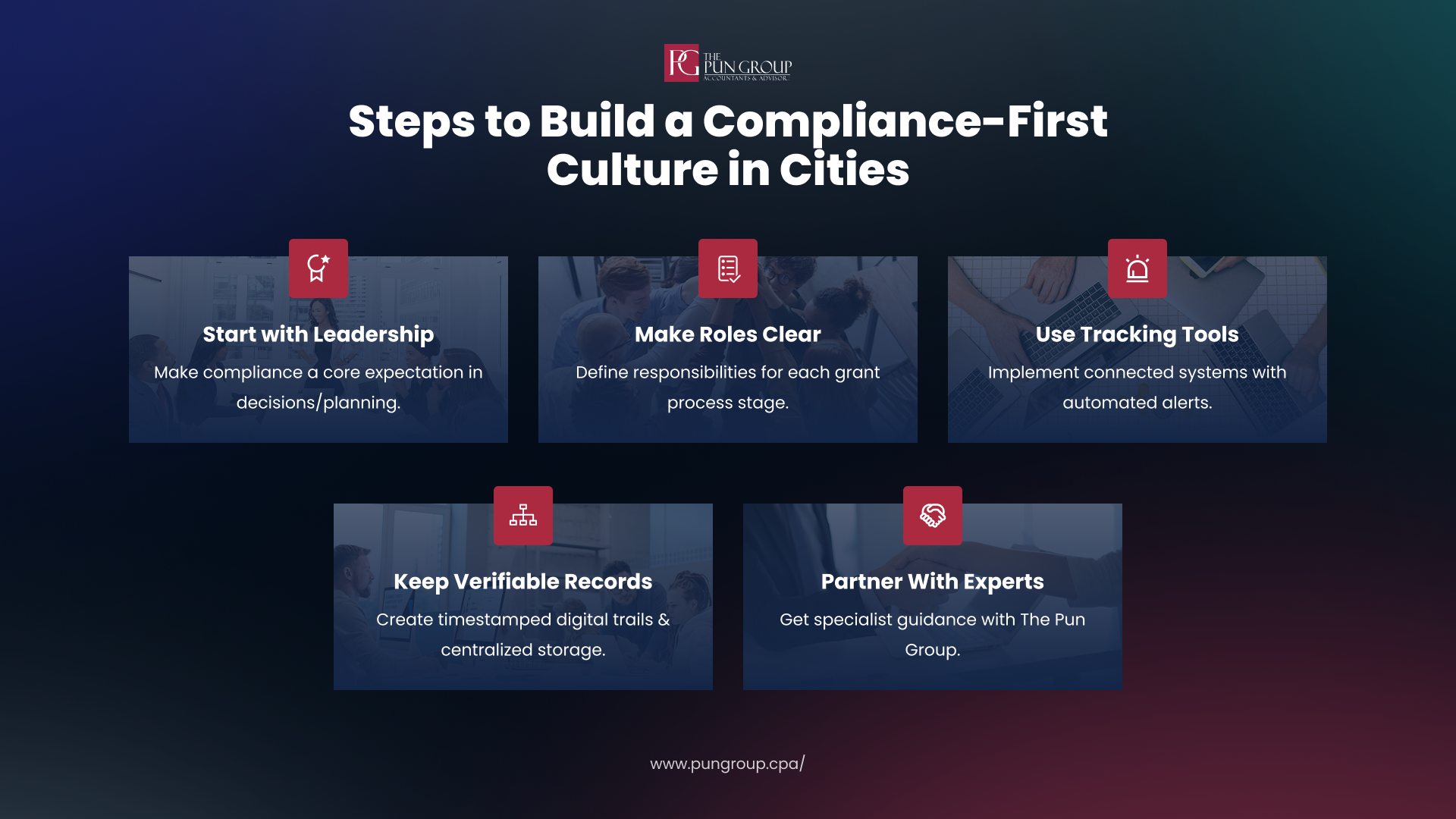
To build a compliance-first culture, start with the leadership, clarify roles, use tracking tools, store records that can be verified, and offer role-specific training. Here are more details:
1. Start With the Leadership
If cities want to build a culture where compliance is treated as a shared responsibility, they need to start at the top. When the leadership makes compliance a core expectation in decisions, planning, and reporting, the rest of the organization follows their lead.
This way, compliance becomes part of a city’s program design and budgetary decisions, which helps it avoid audit findings.
2. Make Roles Clear
Many audit findings come down to confusion over who was responsible for what. To avoid this, cities should write down who is responsible for what at each stage of the grant process. They can start with a lead coordinator who oversees monitoring across departments.
After this, they should map out responsibilities for procurement, documentation, reporting, and subrecipient oversight. Everyone should know who signs off, when, and how it’s tracked.
3. Use Tools That Track the Right Information
Manual processes are hard to track or maintain. Cities should use connected systems, especially with APIs between their financial software and FSRS, to auto-report subawards, track documentation status, and alert their employees to compliance deadlines.
They should also build workflows with tripwires that catch missing files, late reports, or eligibility gaps before they become audit findings.
4. Keep Records That Can Be Verified
Auditors don’t just want to know what you did; they want to see when it happened, who signed off, and where the proof lives.
This means cities should use timestamped digital checklists for monitoring steps, centralize all documents in a secure hub, and build a clean paper trail for every subaward. They could also implement immutable logs for strategic decisions subject to regulations.
5. Partner With Compliance Experts
Building internal compliance expertise takes time that many cities don’t have, especially when federal regulations are constantly changing.
It’s helpful to partner with specialists at The Pun Group to develop training programs, stay current with regulatory changes, and implement practical strategies that work under real-world conditions and tight deadlines.
Trust Experts for Ongoing Monitoring Strategy
Subrecipient monitoring protects federal funds, prevents audit findings, and keeps programs on track. But setting up a system that meets Uniform Guidance requirements while working day to day is a different challenge.
Here are the next steps to take:
- Assess your current monitoring gaps. Review your existing subrecipient files against the 2024 Uniform Guidance requirements and identify where documentation, risk assessments, or oversight procedures fall short.
- Implement automated tracking systems. Incorporate integrated systems that flag compliance deadlines, track corrective actions, and maintain audit-ready documentation trails into your workflow.
- Partner with The Pun Group for an ongoing monitoring strategy. At The Pun Group, we help California cities, counties, and districts create monitoring systems that work under pressure. We provide complete support from initial risk assessment through corrective action planning, so your agency stays audit-ready at every stage.
Want to set up a monitoring strategy that holds up on paper and in practice? Contact The Pun Group today!